Reports
Reports your investors, bank and board actually read
A bluprnts report is a stakeholder-ready document built from your live forecast: a cover page, the headline figures, charts, statement tables, your assumptions and a written narrative. The narrative is written by AI. Every number in the document is computed by the forecasting engine from your model and traces back to the drivers behind it, never produced by a language model. You can create one for investors, a bank or lender, or your board, export it to PDF and share it as a link.
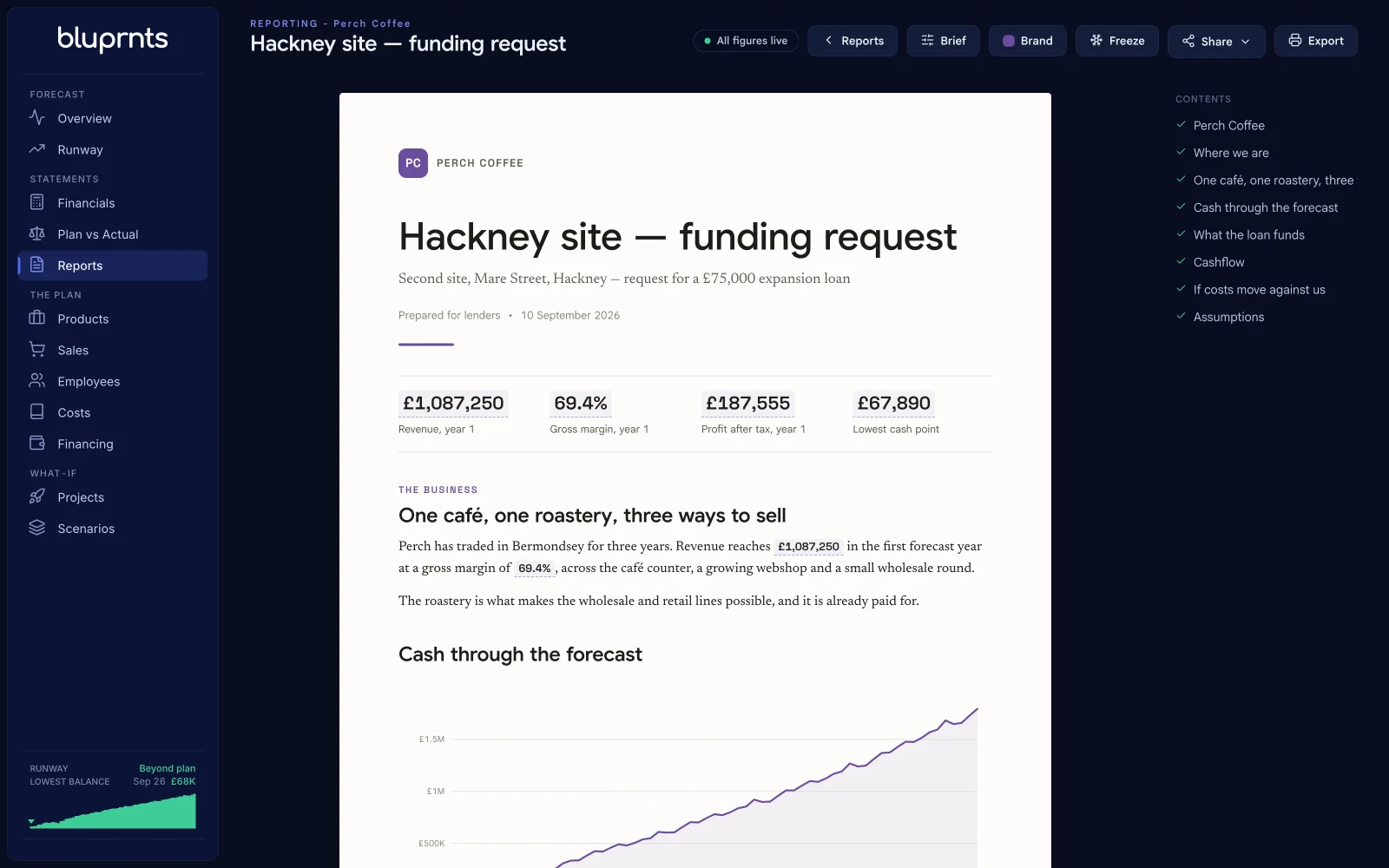
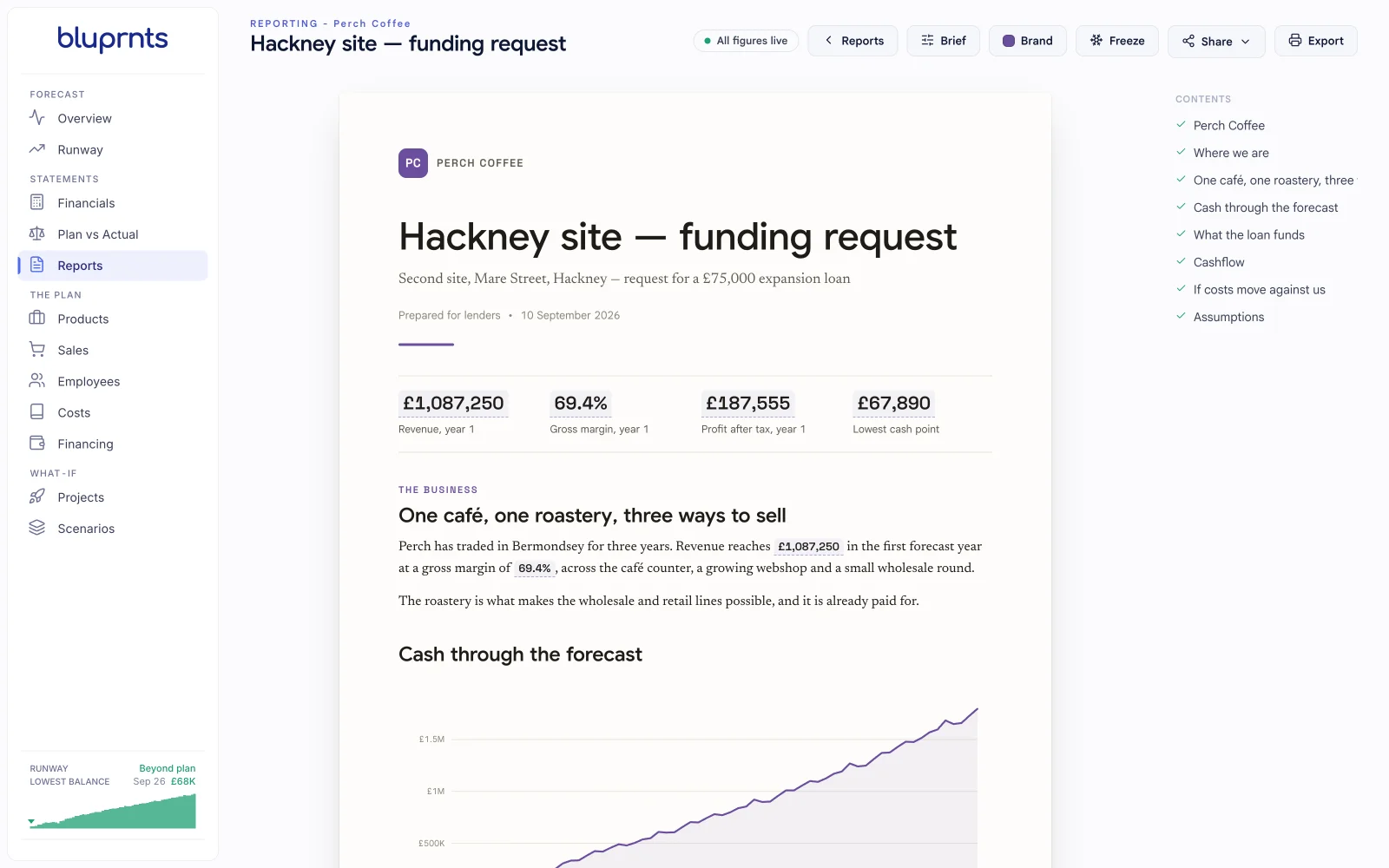
What goes into a report?
A report is a document, not a dashboard export. It reads in the order a reader expects, and every part of it is drawn from your live model.
01
Cover
Your business, the report's title and its one-line purpose, who it is prepared for, and the date it was produced.
02
Headline figures
The four or so numbers that decide how the rest is read: revenue, margin, profit after tax, and the lowest cash point in the period.
03
Narrative sections
Written passages about the business and the request, with the figures set inline in the prose rather than left in a table for the reader to reconcile.
04
Charts
Cash through the forecast, with the low point marked and the events that explain its shape called out.
05
Statement tables
The full cash flow, year by year, down to the individual lines: money in from customers, money out to suppliers and staff, VAT, tax, interest, capital expenditure, borrowing and repayment.
06
Sensitivity
The plan next to a downside scenario, on the rows that matter: revenue, gross profit, profit after tax, closing cash, lowest cash point and runway.
07
Assumptions register
Forecast start and length, currency, opening balances, customer and supplier payment profiles, VAT treatment, corporation tax, employer national insurance, interest rates. The things a careful reader would otherwise have to ask about.
The assumptions register is the part most people underestimate. A lender's first serious question is almost always "what have you assumed", and a document that has already answered it is a shorter conversation than one that has not.
Who is each report for?
Investors
For a raise, the questions are how big the opportunity is, how the money gets spent and how long it lasts. An investor report leads on the growth in the plan and the runway the round buys, with the assumptions visible so diligence starts from your numbers rather than from a rebuild of them.
Banks and lenders
A lender is asking a narrower question: can this business service the debt, and what happens if trading is worse than planned. A funding request states what the loan funds, shows the cash position through the term, and puts a downside case next to the base plan rather than waiting to be asked for one.
Boards
A board update is about direction and exceptions: where the plan stands, what moved since last time, and which decisions are being brought to the table. Because the report is generated from the live model, "since last time" is a rerun rather than a rebuild.
Where do the numbers come from?
From the model, computed by the engine, every one of them. That sentence is doing more work than it looks like, so it is worth unpacking.
In a report assembled by hand, the figures are copied. They were correct in the spreadsheet on the morning they were pasted, and after that they are just characters on a page. Nobody can tell by looking whether the revenue figure in paragraph two and the one in the table three pages later came from the same version of the plan, and often they did not.
Here, a figure in the prose and a figure in a table are the same figure, because both are reading the same model at the moment the document is produced.
That is also what makes the numbers defensible. Every figure traces back through the derivation to the drivers that produced it: the products, the people, the costs, the financing. When an investor, a lender or an auditor asks why a number is what it is, the answer is a path through the model rather than an assurance. It is the difference between being believed and being checkable.
What does the AI write, and what does it not?
The narrative is written by AI. The numbers are not, and the distinction is absolute.
What the assistant writes is the prose around the figures: the description of the business, the framing of the request, the sentence explaining why cash dips in month eleven. It reads the model and describes what is there, which is the slow, tedious part of producing a report and the part that most often does not get done well under time pressure.
What it never does is produce a figure. Every number in the document, in the headline strip, in the prose, in the tables and on the charts, is computed by the forecasting engine from your model. A language model is not asked to estimate, round, infer or summarise a number, because a plausible-looking figure that nothing produced is the single worst thing that could appear in a document you are handing to a lender.
Each report says so on its own last line, which is the form the promise should take: not a claim on a marketing page, but a statement on the document itself.
Proof
The demo carries real reports on a real model. Perch Coffee, the café and roastery it opens on, has a funding request prepared for lenders covering a second site, and an internal review of its wholesale and webshop lines. Both are generated from the same drivers that produce its statements, and both can be read end to end without an account.
Questions about reports
- Can I brand a report?
- Yes, within limits. A report carries your company logo and your brand colour, which runs through the document as its accent. You also set the title, the audience it is written for — investors, lenders, board or internal — and the tone, from confident to conservative, and you can give the AI a brief for what the narrative should centre on.
- What do I actually send someone?
- A PDF, produced through your browser from the finished report and named after it. Clean export is included on Growth and Scale; on Starter the printed pages carry a bluprnts watermark. Starter also holds one report at a time, where Growth and Scale are unlimited.
- Can the person I send it to see my underlying model?
- No. What leaves bluprnts is the document, not access to your account. An investor, lender or board member sees the figures, charts and narrative you chose to include and nothing else — not the drivers behind them, not your other scenarios, not your other reports.
- Does a report update when the forecast changes?
- While it is a draft, yes — it resolves its figures from the engine each time you open it, so it follows the model as you change it. Freezing a report fixes every figure as presented at that moment and records when it was frozen, which is what you want before it goes out: the copy you discuss afterwards is the copy someone actually received. Unfreezing puts it back to following the model.
- Is the narrative written by AI?
- The prose is drafted by AI from your own figures, and you edit it. Numbers are never written into the text as literals — every figure in the narrative is a reference the document resolves from the engine, so the words and the statements in the same report cannot disagree with each other.
Model the business. The statements follow.
Free to start. No accounting data required.
Get started7-day free trial · no card