Guided setup
Start your cash flow forecast from your website
bluprnts is the only cash flow forecasting tool that starts from your website. Give it your address and it reads your own pages, then opens guided setup with the answers already filled in — what you sell, what you charge, where you trade, who works there — for you to confirm or correct.
How does it work?
You type your domain — on the homepage, or on the first question of setup — and bluprnts goes and reads your site while you carry on.
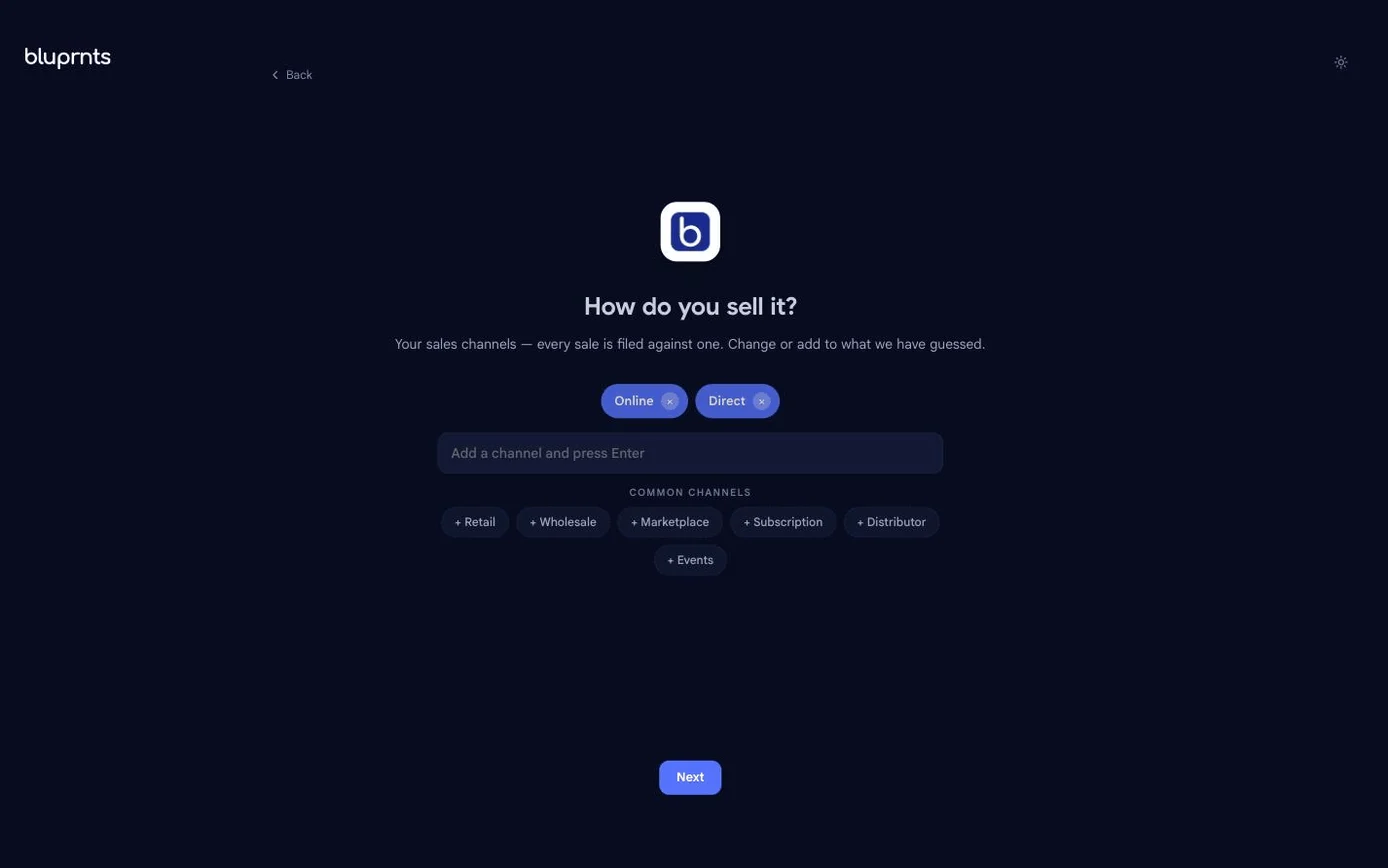
What comes back is not a forecast. It is a set of answers, dropped into the questions guided setup was going to ask you anyway. Your products arrive with prices against them. Your premises arrive with a count. Your team arrives with roles on it. Each one sits in a field you can accept, edit or delete.
Then you work through them. As you confirm each answer the model builds underneath, and your runway and bank balance move in the sidebar beside the question you are on — so the forecast is assembling itself in front of you rather than appearing at the end.
Nothing enters the model until you have confirmed it. That is the whole contract of this feature, and it is the reason the answers can be useful without being dangerous.
What does it fill in?
The things a forecast is actually made of:
- What you sell, and what you charge for it. Grouped into lines you could forecast against rather than a row for every item in your shop — and split apart again where the prices inside a group are too far apart to average honestly.
- Where you trade. The kind of premises, how many, and the capacity in whatever unit your business counts in — covers, chairs, rooms, desks.
- Who works there. The roles and teams your site puts its name to.
- Who you are. Your registered name, company number and the rest of the formalities, so you are not typing them.
It is deliberately narrow. These are the drivers that move a cash flow forecast, and the read is aimed at them rather than at building a general picture of your company.
What if it gets something wrong?
You correct it, in the question it appears in. This is worth being plain about, because it is the difference between a feature that helps and one that quietly damages your plan.
Every field it returns is a claim about your business, not a fact about it. It is built to be obviously wrong rather than plausibly wrong — a price it could not find is a price it leaves out, and a thin site earns short answers rather than a longer guess. The aim is to be right often enough to be worth a glance, not to be trusted unchecked.
That is also why nothing is written behind you. A forecast whose inputs you did not choose is not a forecast you can defend to a lender, and defensibility is the point of the whole product.
What does the AI do, and what does it not?
The AI reads your website and proposes the inputs: a product line, a price it found on your page, how many it expects you to sell, a job title, a count of premises. Every one of them is shown to you, and you can change any of them.
Every figure in your forecast is computed by the bluprnts engine, from those inputs, and traces back to them. Your runway, your breakeven month, every line of the P&L, balance sheet and cash flow statement. The AI calculates none of them.
This is not modesty. Language models are unreliable with arithmetic and cannot show their working, so a forecast written by one is worth nothing to the investor or lender you are showing it to. The split — AI reads and proposes, the engine computes and traces — is what makes the output defensible when somebody pulls on a number.
Who it's for
Founders starting from nothing
Pre-revenue, a new venture, an idea with a landing page. There are no books to connect and nothing to extrapolate, but there is usually a site — and that is enough to start from. More for founders.
Businesses whose bookkeeping is behind
The group that ledger-based tools quietly exclude. If your accounts are three months out of date, a tool that forecasts from them cannot help you until you have fixed that. This one does not ask.
Advisors setting a client up
A client's website is something you have before the first meeting, and a half-built model is a better thing to walk them through than an empty one.More for advisors.
Proof
Every sample company on this site was modelled this way round — drivers in, statements out, no accounting system attached to any of them. It is the end state this page is describing the entrance to: five years of statements, runway, scenarios and finished reports, built from nothing but the business itself.
Questions about guided setup
- What if I do not have a website?
- Guided setup still runs, you just answer the questions yourself instead of confirming answers. It walks you through the five driver types in order — products, sales, people, costs and financing — and the forecast builds as you go. The website is a shortcut through the typing, not a requirement.
- How long does it take?
- A few minutes. You give your website address, confirm or correct what comes back, and the forecast is there at the end of it. There is nothing to connect, no accounting data to prepare and no template to fill in first.
- My site is one page. Is that enough?
- It will give you less. A thin site produces fewer answers rather than invented ones, which is the behaviour you want from it — anything else would be putting figures into your plan that nobody chose. You fill the gaps in the questions that follow, exactly as you would have done anyway.
- Does the AI calculate my forecast?
- No, and the distinction matters. It reads your pages and proposes the inputs — what you sell, what you charge, how much you sell, where you trade — and you can see and change every one. Every figure in the forecast is then computed by the bluprnts engine from those inputs, and traces back to them. The AI calculates none of the outputs.
- Do I still need to connect Xero?
- No. Xero is optional and always has been: it grounds the model against real actuals once you have them. The forecast works fully without it, which is the whole point of building from drivers rather than from a ledger.