Cash flow forecast
A three-way cash flow forecast, derived from your model
A three-way forecast projects your profit and loss, balance sheet and cash flow statement together, so the three always agree. bluprnts derives all three from the drivers you model, and reads your bank balance, runway, breakeven point, sales forecast and ratios off them, month by month.
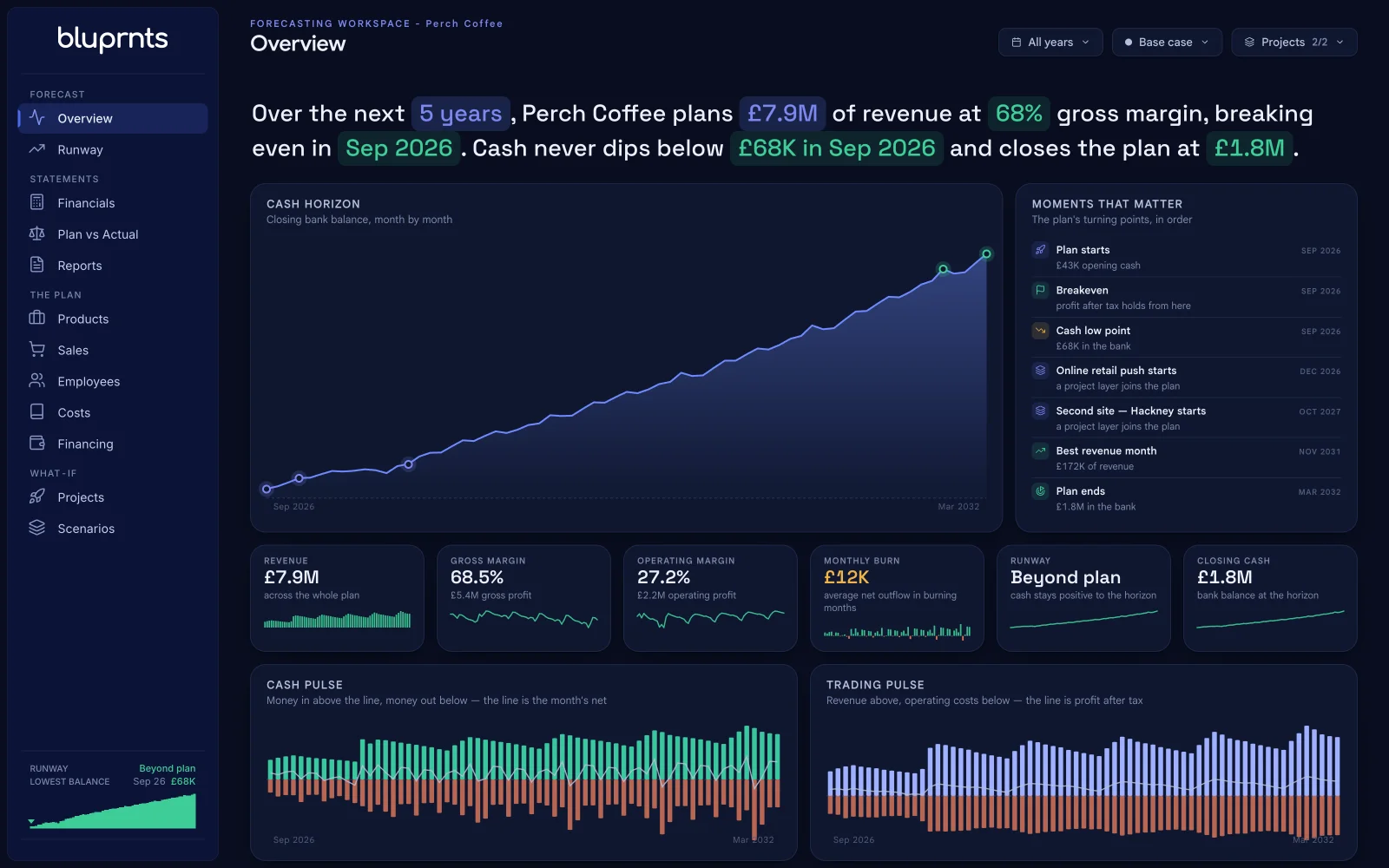
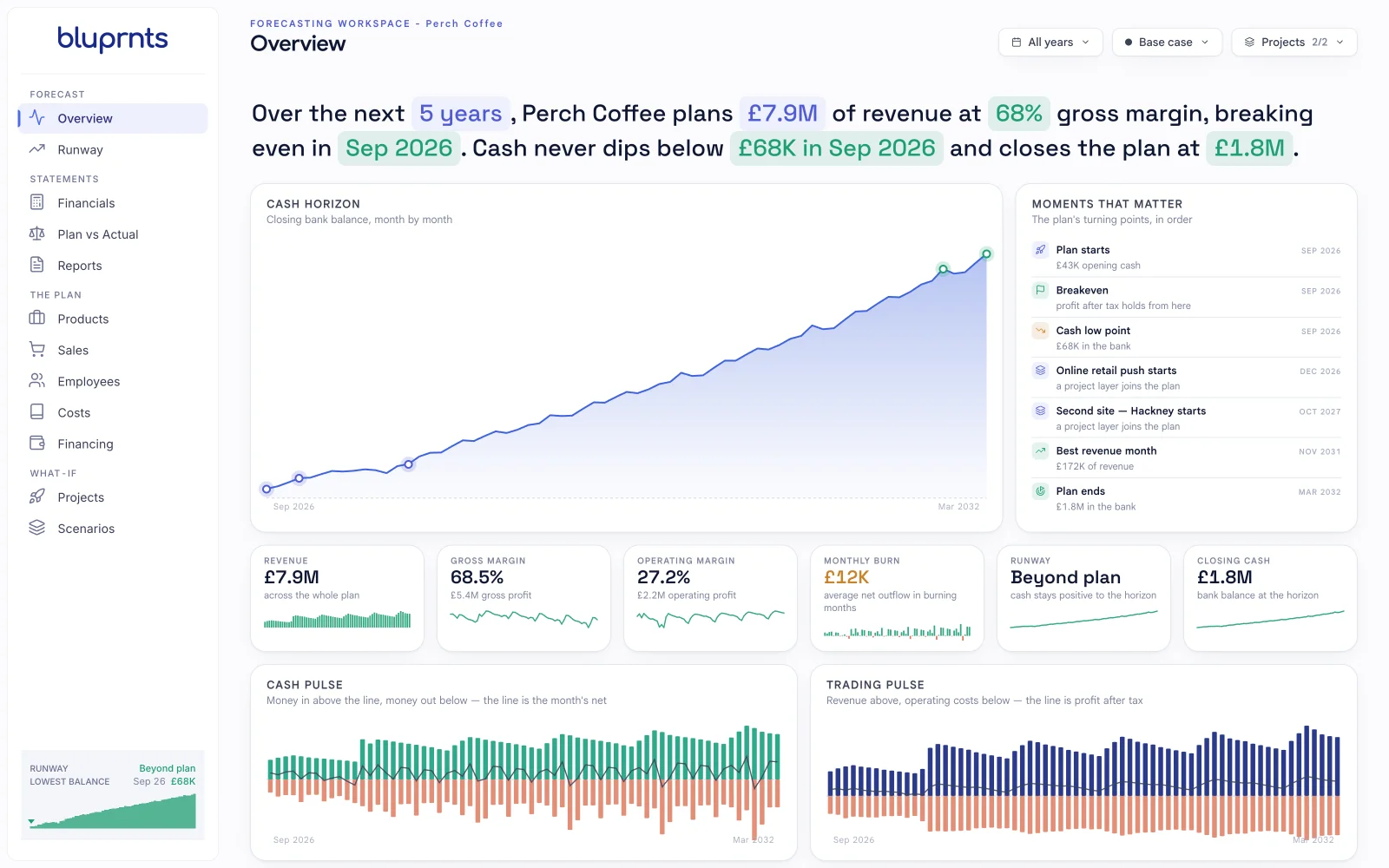
What is a three-way cash flow forecast?
A three-way forecast is a projection of all three primary financial statements together: the profit and loss, the balance sheet and the cash flow statement. They are called three-way because they are linked. Profit flows into retained earnings on the balance sheet, movements on the balance sheet explain the difference between profit and cash, and the cash flow statement lands on a bank balance the balance sheet agrees with.
The reason it matters is the gap between profit and cash. A profitable month can still be a month you cannot make payroll, because the sale was invoiced on sixty-day terms, the VAT bill fell due, and the loan repayment went out. A cash flow forecast on its own hides why. A three-way forecast shows the whole mechanism.
Building a three-way forecast by hand is the part of the spreadsheet that takes longest and breaks quietest. In bluprnts it is not built at all. It is derived from your model, so the three statements cannot disagree with each other.
What statements do you get?
Every one of these is computed from your drivers, month by month, and can also be read quarterly or yearly.
- Profit and loss. Revenue, cost of sales, gross profit, operating costs, profit before and after tax. Answers whether the business model works.
- Balance sheet. What the business owns and owes, including the assets your capital expenditure created and the debt your financing carries. Answers what the business is standing on.
- Cash flow statement. Money in from customers, money out to suppliers and staff, VAT, tax, interest, capital expenditure, borrowing and repayment, each on its own line. Answers where the money actually went.
- Bank balance. The closing cash position at the end of every month across the horizon. Answers the question everybody actually asks first.
- Sales forecast. Revenue broken down by product and by channel. Answers which part of the business is carrying the plan.
- Ratios and margins. Gross margin, operating margin and the standard ratios. Answers whether the shape of the business is improving or just getting bigger.
Because they share one source, changing a driver moves all of them at once. Raise a price and the P&L, the balance sheet, the cash flow statement, the runway and the reports all follow from the same edit.
How is runway calculated?
Runway is how long your cash lasts. The textbook formula is cash balance divided by net monthly burn, and it is a reasonable first approximation.bluprnts does not use it, because dividing by an average assumes every month is the same and no business has that.
Instead, runway is read off the forecast cash path. The model already produces a closing bank balance for every month, so the runway answer is simply the first month that balance goes below zero, and the lowest point it reaches before then. If it never goes below zero across the horizon, the answer is that the plan is funded and the figure worth knowing is the low point rather than a date.
The difference is not academic. A business can average a comfortable burn all year and still be short in March, and a divided average will never show you March.
That is also why the answer comes with a month attached. Knowing you have "about seven months" is less useful than knowing the tightest point is next February and it is £54,932.
When do you break even?
Breakeven is the month your business stops losing money and starts making it, and inbluprnts it is a derived output rather than a separate exercise. Because the P&L is already computed for every month of the forecast, the breakeven month is the point at which profit after tax turns positive and stays there.
It appears alongside your runway rather than in a different calculation, which matters because the two answer different halves of the same worry. Runway tells you how long the cash lasts. Breakeven tells you whether you need it to last that long.
Both move when the plan moves. Add a hire and the breakeven month slides out; raise a price and it pulls in. Because they are read off the same model, they cannot tell you two different stories.
How far ahead does it forecast?
Five years by default, month by month, from a start date you choose. The horizon is a model setting rather than a fixed limit, so a shorter plan is a matter of changing it.
Every statement can be viewed monthly, quarterly or yearly. Monthly is where cash questions live, because a quarterly view averages away the month you were worried about. Yearly is what a lender or an investor usually wants to see first.
The forecast also carries the timing rules that decide when money actually moves rather than when it is earned: how your customers and suppliers split across 30, 60 and 90 day terms, your VAT registration and filing frequency, corporation tax, and employer national insurance. Those settings are the reason a bluprnts cash flow statement differs from a simple projection of your P&L, and they are the reason it is worth having.
Proof
These are real statements from the live demo, computed from that company's drivers. No accounting system is connected to it.
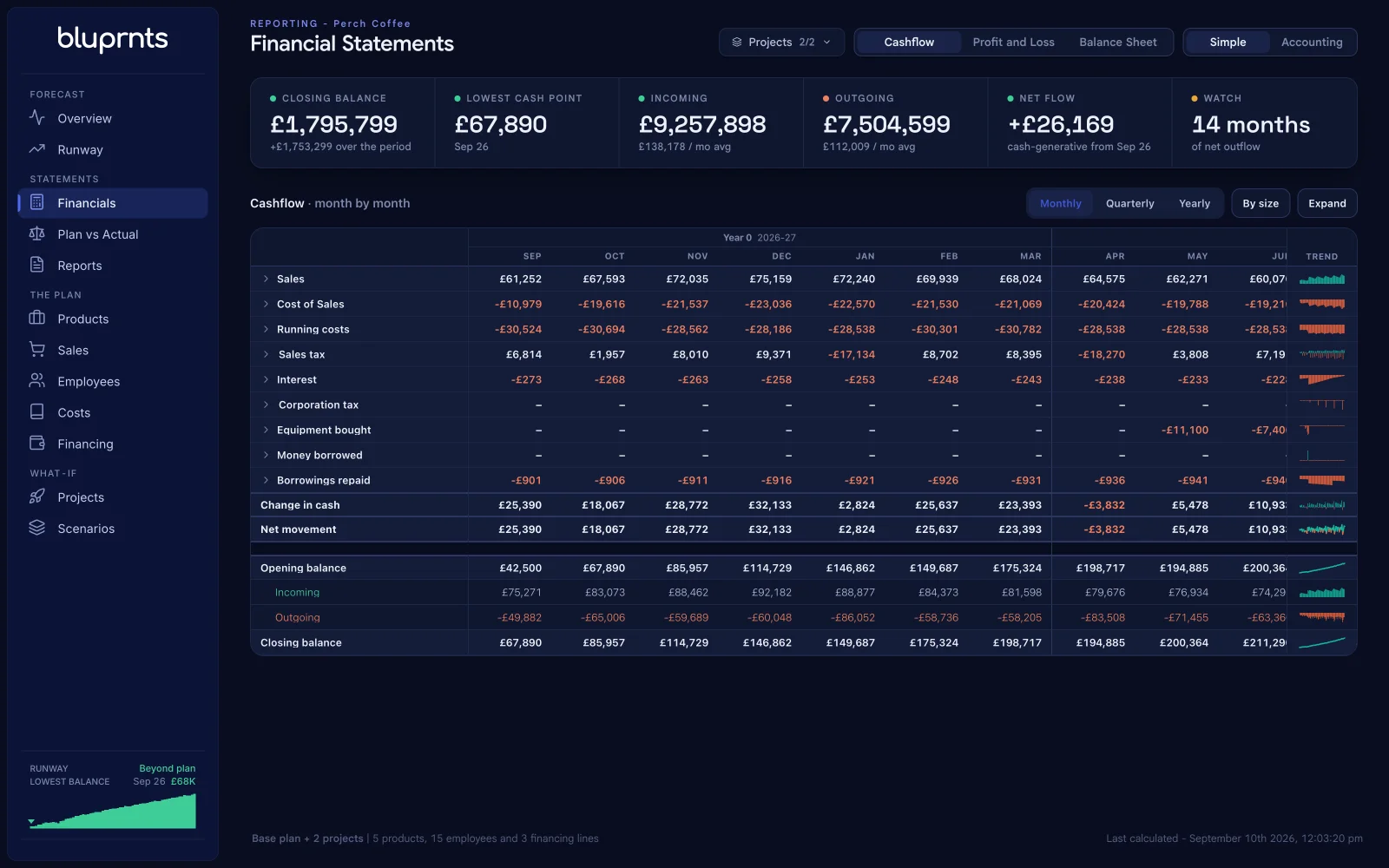
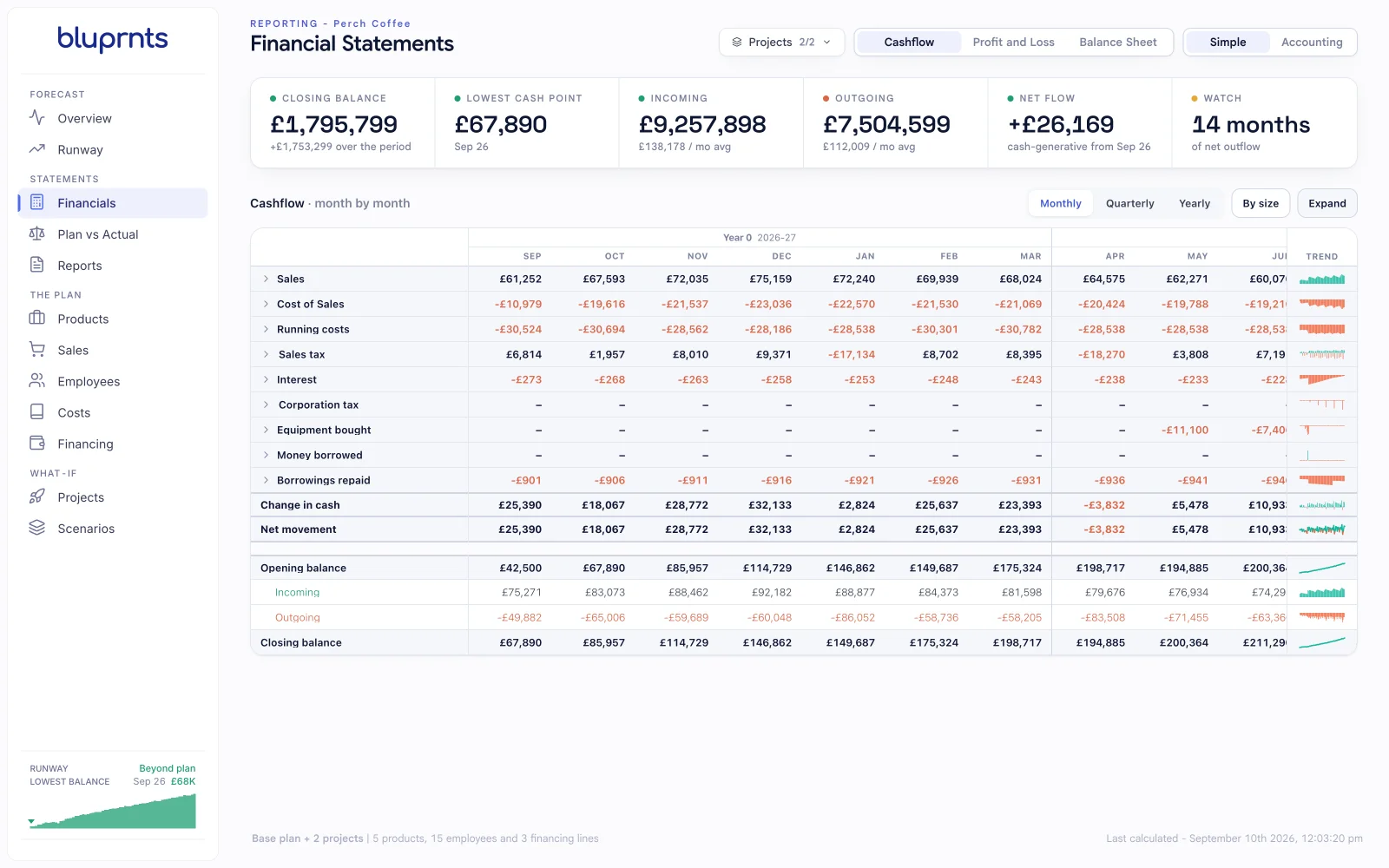
Every figure traces back to what produced it. Open a number in the statements and you can follow it down to the products, people, costs and financing behind it. Nothing is extrapolated and nothing is hidden inside a formula, which is what lets you defend the forecast to an investor, a lender or an auditor rather than asking them to take it on trust.
Questions about the forecast
- Do I need accounting knowledge to read the forecast?
- No. You describe the business in operational terms — what you sell and at what price, who you employ, what you spend, what you have borrowed or raised — and bluprnts derives the accounting from it. The P&L, balance sheet and cash flow statement come out as outputs to read rather than templates to fill in.
- Do the three statements reconcile?
- Yes, by construction. The balance sheet is derived from the P&L and the cash flow rather than kept alongside them, so there is no separate place to enter a balance that contradicts the other two. Every figure also traces back to the drivers that produced it, so any number in a statement can be followed to the assumption behind it.
- Which accounting standard are the statements presented under?
- FRS 102 by default. You can switch a model to IFRS or US GAAP presentation, which changes how the statements are laid out — for example where interest sits in the cash flow statement.
- Can I forecast in a currency other than pounds?
- Yes. A model reports in one currency, which you choose in its settings along with the country, tax year end, VAT treatment and corporation tax rate. The default is pounds sterling. bluprnts does not convert between currencies or consolidate several of them inside one forecast, so a business trading in more than one models in its reporting currency.
- How often does the forecast recompute?
- Immediately. Every figure is computed from your drivers rather than stored, so changing a price, a hire, a payment term or a loan recomputes the statements, the bank balance, runway and breakeven as you make the change. There is no rebuild step and nothing to refresh.
Model the business. The statements follow.
Free to start. No accounting data required.
Get started7-day free trial · no card