The model
Driver-based financial modelling, built from your business
A driver-based financial model is built from the things a business actually controls — its products and prices, sales volumes, employees, costs and financing — rather than extrapolated from past accounting data. In bluprnts you enter those five drivers, and the forecast P&L, balance sheet, cash flow, runway and breakeven are derived from them.
What is a driver-based financial model?
A driver-based financial model starts from the operational decisions that produce the money, and calculates the accounting from them. The drivers are the things you set: what you sell, at what price, in what volume; who you employ and from when; what you spend and what you have borrowed. The profit and loss, balance sheet and cash flow statement are not entered anywhere. They are computed.
The alternative approach, used by most cash flow tools that plug into an accounting ledger, is to take your historical figures and project them forward. That works well when the future resembles the past. It has two limits. A business with no trading history has nothing to extrapolate from, and a business planning a change is asking precisely the question that a projection of its history cannot answer.
The distinction is that a driver-based model can answer "what happens if we do this", because the thing you are proposing to do is an input. In an extrapolation, it isn't.
Being driver-based is not unique to bluprnts. Several financial planning tools built for startups work the same way, and we say so on thecomparison pages rather than claiming a mechanism we share. The sharp difference is against the tools built on top of Xero or QuickBooks, where the accounting data is the model.
What do you actually enter?
Five domains, each modelled record by record. Everything below is an input you set. Nothing below is an accounting entry.
01
Products
What you sell and its unit economics: retail price, production cost, storage, shipping and whether VAT applies. The gross margin per unit falls out of those.
An espresso drink at £4.00 a unit, keeping £2.94 after production cost: an 82% margin.
02
Sales
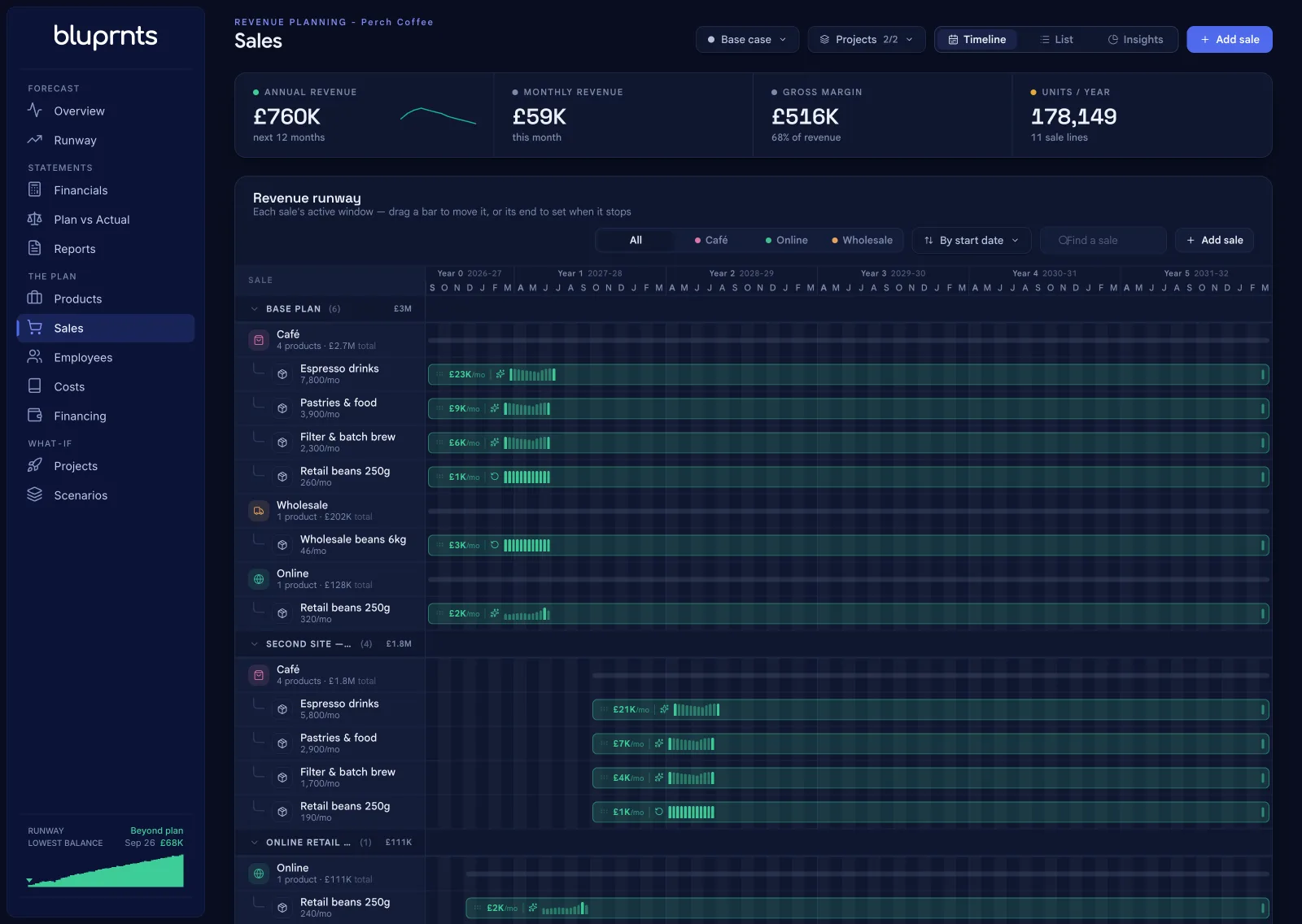
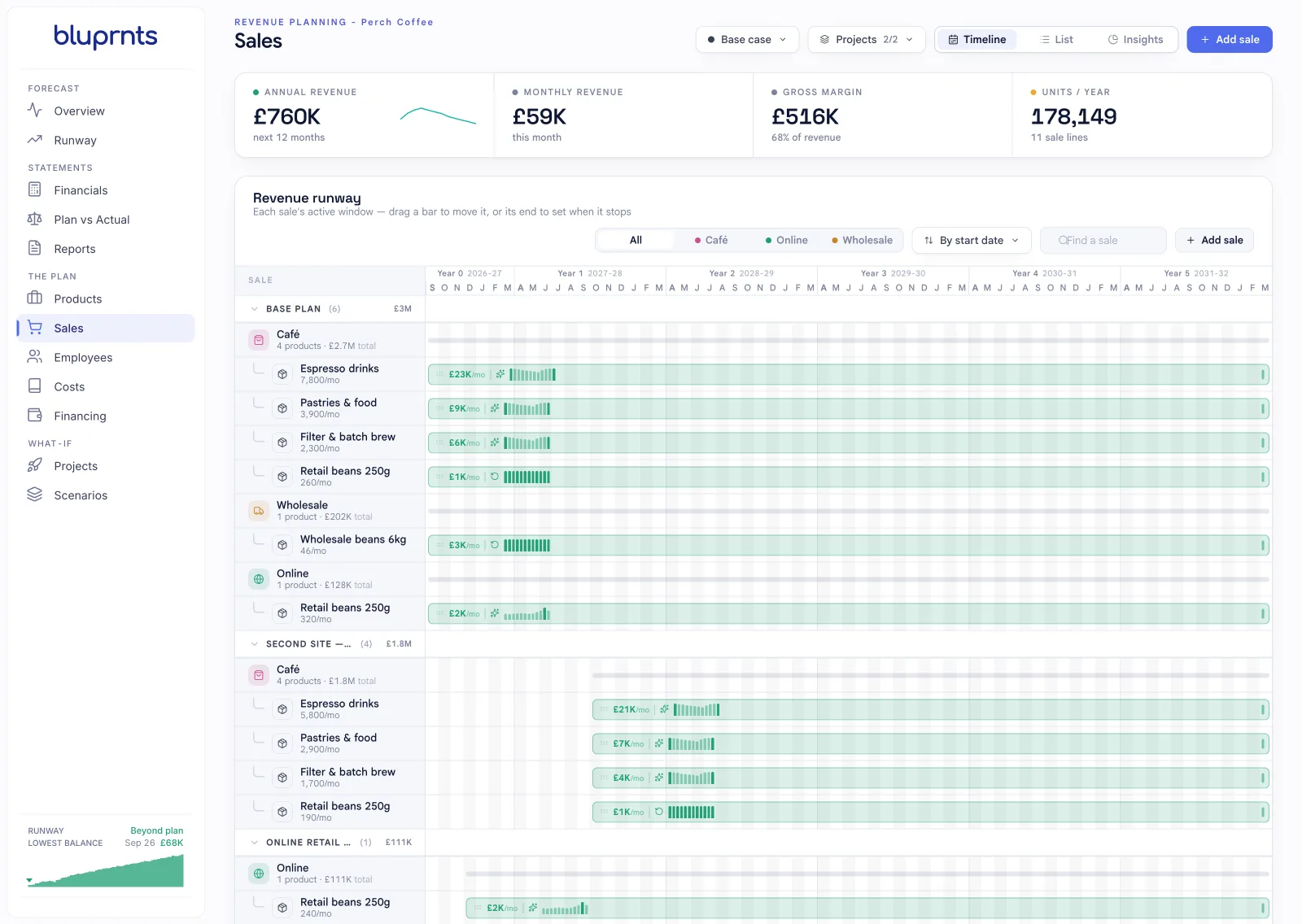
How much of each product you expect to sell, through which channel, starting when and for how long, with a seasonality curve if demand is not flat through the year.
7,800 espresso drinks a month over the counter, and 46 six-kilo wholesale bags at £84.
03
Employees
Named people and planned roles, with salary, start date and department. Hiring waves let you add several of a role over time. Employer national insurance and pension are added on top rather than being something you work out.
Two full-time baristas, joining as a wave rather than on day one.
04
Costs
Recurring costs, one-off payments and capital expenditure, each with its own category, amount and window. Capitalised assets depreciate rather than hitting the month they are bought.
Rent and service charge at £3,250 a month; a £62,000 fit-out capitalised in the month it is paid.
05
Financing
Loans and investment rounds, with amounts, rates and terms. Drawdown, repayment schedule and interest are all modelled on their own timing.
A £75,000 expansion loan at 7.2%, running to 2032.
Two settings sit underneath all five and decide when the money actually moves: your payment profile (how your customers and suppliers split across 30, 60 and 90 days) and your tax treatment (VAT registration and frequency, corporation tax rate, employer national insurance). These are the difference between a forecast of profit and a forecast of cash.
You can also layer a project on top of the base plan: a new site, a new market, a product launch, with its own sales, hires, costs and financing. The forecast then shows the business with and without it.
Where do the statements come from?
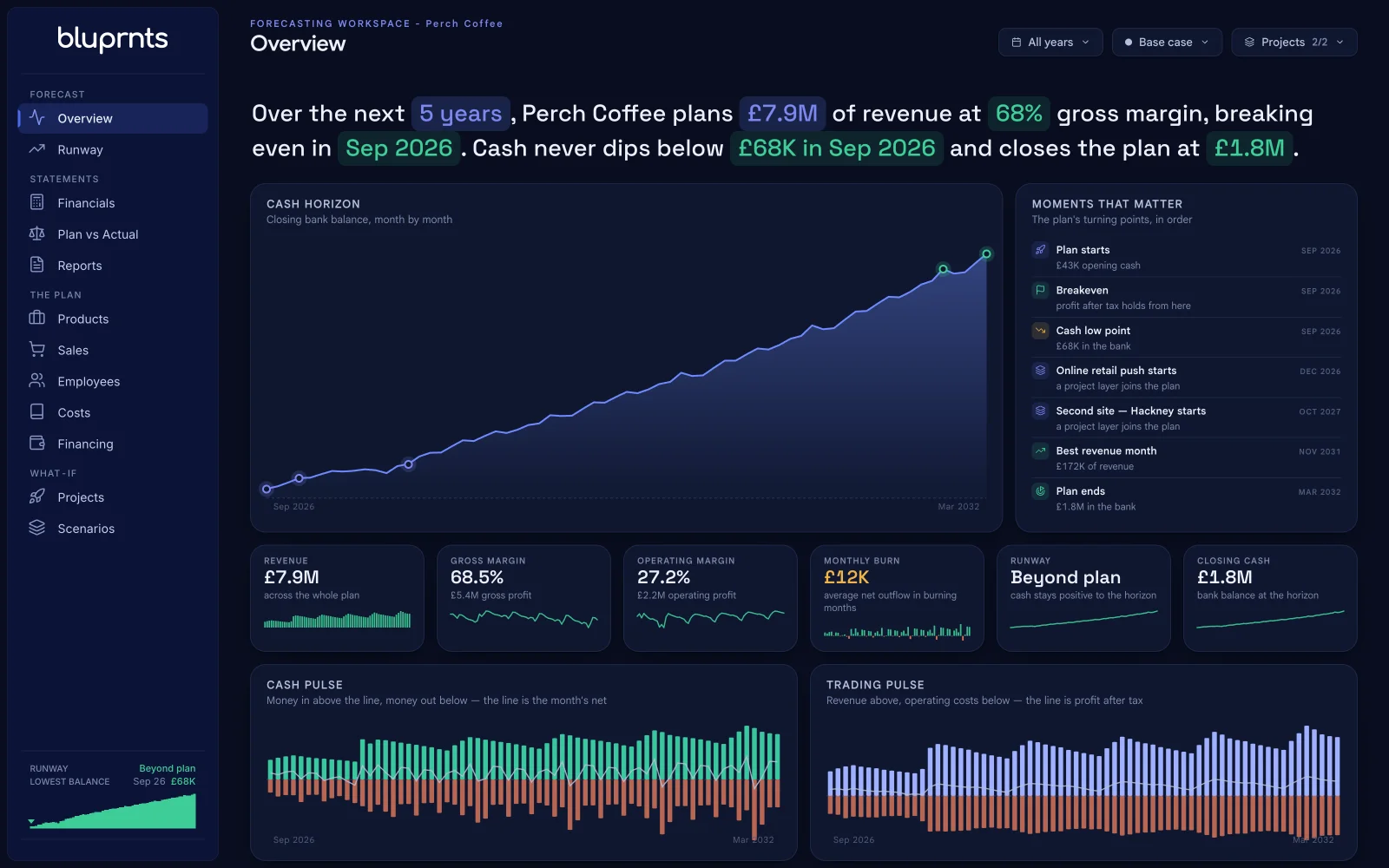
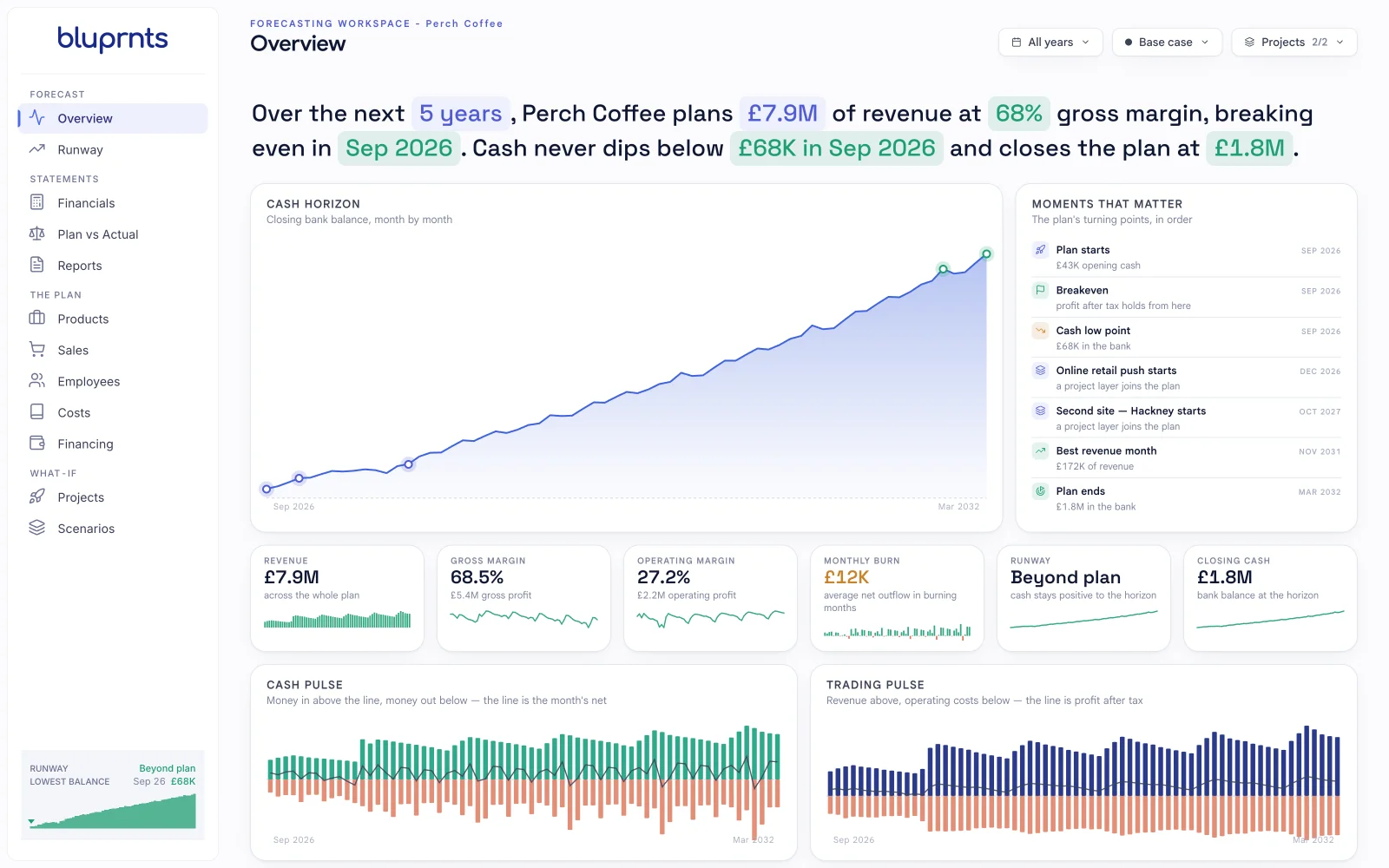
From the drivers, and only from the drivers.bluprnts runs the model month by month across the whole horizon and derives:
- Profit and loss, month by month, quarterly or yearly
- Balance sheet, including the assets your capex created
- Cash flow statement, with money in and out separated
- Bank balance at the end of every month
- Sales forecast by product and channel
- Runway and breakeven, read off the cash path rather than from an average
- Ratios and margins, gross and operating
Because every figure is computed rather than typed, every figure can be traced. Open a number in the statements and you can follow it back to the products, people, costs and financing that produced it. That is what makes the output defensible to somebody who was not in the room when the model was built: an investor, a lender, an accountant or an auditor can be shown the derivation instead of being asked to trust it.
Do I need accounting data to start?
No. There is nothing to connect and nothing to import before you can build a forecast. The model is made of your own decisions, so the inputs exist whether or not the business has a trading history.
That matters in three situations that a ledger-based tool cannot serve at all:
- Pre-revenue. No sales yet means no history to project. You can still model the products you intend to sell and the people you intend to hire.
- A new venture. A business that does not exist has no books by definition, and is usually the one that most needs a forecast to raise against.
- A new product, market or site. The existing books describe the existing business, and say nothing about the thing you are considering adding to it.
If you do keep books, Xero can be connected to bring your actuals in alongside the forecast, so you can see the plan against what happened. It is an input that grounds the model. It is not the engine, and the model works without it.
Who it's for
Founders and startups
Founders use a driver-based model because the questions they face are decisions, not trends: when to hire, what to charge, whether the round lasts long enough. The model takes those as inputs, so the runway figure moves when the plan does.More for founders.
Small businesses
An owner-managed business already thinks in products, staff, rent and stock. A driver-based model is that vocabulary, so building the forecast does not require learning accounting first, and the resulting statements are still the ones a bank expects to see.
Finance teams
A finance lead gets an auditable model rather than a spreadsheet with logic buried in cells. Every output traces to an input, the statements stay in sync with each other, and assumptions are recorded as fields instead of conventions.
Accountants and advisors
Advisors use it because the client can follow it. A model built from products, people and costs is one a director can review and challenge, which is harder with a projection derived from their own ledger.More for advisors.
Proof
The live demo is the argument. It opens on a made-up café and roastery whose entire forecast is built from five products, eleven sale lines, nine roles, thirty-four costs and three financing lines, plus two projects layered on top. No accounting data is connected to it. Every statement, the runway and the closing balance are derived from those drivers, and you can change any of them and watch the rest move.
Questions about the model
- How long does it take to build a model?
- There is no minimum model to get an answer. bluprnts produces a full set of statements from whatever drivers you have entered, so a rough first pass already gives you a forecast, and you refine it from there rather than finishing before you see anything. Guided onboarding walks you through the five driver types in order — products, sales, people, costs and financing — so the first pass is a sequence of questions about your business rather than a blank sheet.
- Do I need accounting knowledge to build the model?
- No. Every input is operational: what you sell and at what price, who you employ and when they start, what you spend, what you have borrowed or raised. The accounting is derived from those inputs, so the statements are what you get out rather than what you assemble.
- How detailed can the model get?
- As detailed as the business is. Products carry their own prices, volumes and production costs; sales can be split by channel; people carry salaries, start dates, departments and roles; costs and financing are modelled one by one. Payment behaviour is modelled too — how your debtors and creditors split across 30, 60 and 90 days, VAT treatment and frequency, corporation tax and employer national insurance. A scenario change can then be scoped to a single product, channel, department, role or cost rather than applied across everything.
- How far ahead does the model run?
- Five years by default, month by month, from a start date you set. The horizon is a model setting, so you can shorten or extend it.
- Can I import my existing spreadsheet?
- Not today — there is no spreadsheet import. You enter the drivers directly, which is less work than it sounds: you are entering the decisions you already know rather than reconstructing the formulas that connect them, and the statements that took longest to wire up in the spreadsheet are the part bluprnts derives for you.
Model the business. The statements follow.
Free to start. No accounting data required.
Get started7-day free trial · no card
Where to next
- All featuresThe rest of the capability set
- Cash flow forecastThe statements the model derives
- Scenario planningFork the model and compare futures
- PricingPlans, trial terms and what each tier includes
- LearnExplainers on forecasting and cash flow
- Why we built it this wayThe case for modelling over extrapolation